Life Before WiFi: When Kids Played Outside Until the Streetlights Came On
Remember when summer meant disappearing after breakfast and coming home when the streetlights flickered on? A look back at childhood before screens took over and how technology changed the way kids play forever.
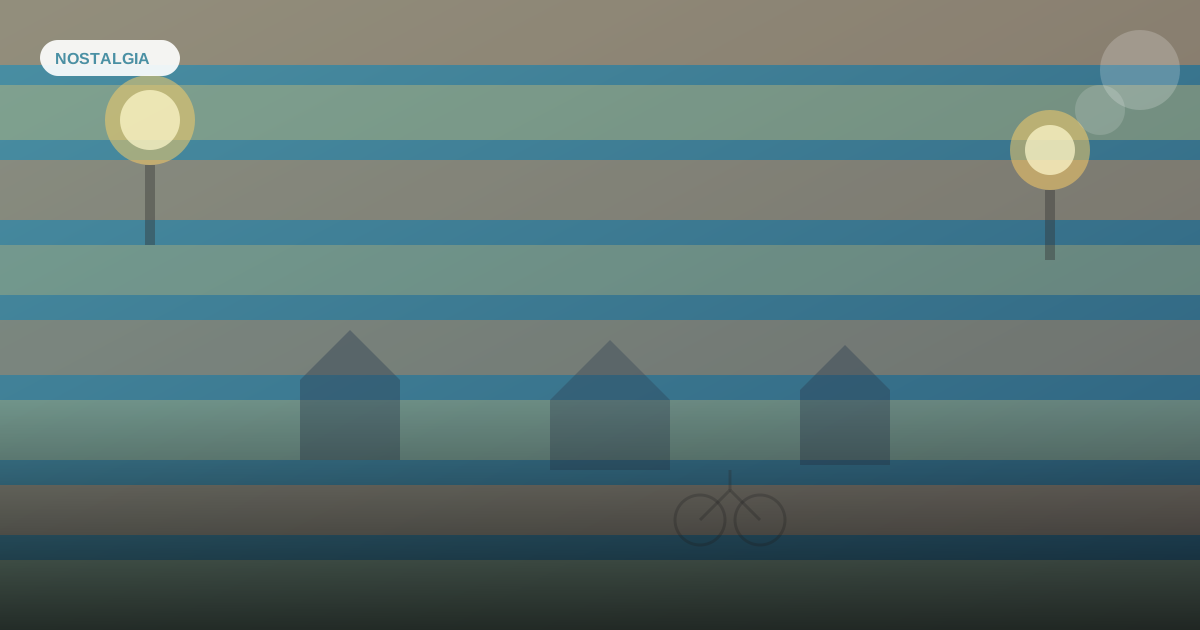
The Sound of Summer
Close your eyes and think about summer in 1985. What do you hear?
Screen doors slamming. Bicycle chains clicking. The thwack of a baseball hitting a leather glove. Kids screaming "you're it" somewhere down the block. The distant melody of the ice cream truck getting closer, sending every kid within a half-mile radius sprinting for home to beg their parents for a dollar.
That was the soundtrack of childhood before WiFi. Before tablets and smartphones and streaming services and social media. Before the internet rewired everything about how we live, work, and play.
I'm not here to tell you that everything was better back then. It wasn't. But something was different. Something important. And if you grew up in that era, you know exactly what I mean.
The Morning Ritual
Summer mornings started the same way every day. You'd shovel down a bowl of cereal while watching cartoons—the only screen time you'd get until evening. By nine o'clock, your mom was already tired of you being underfoot.
"Go outside and play," she'd say. It wasn't a suggestion.
So you'd go. You'd walk out the front door with nothing but the clothes on your back—maybe a few quarters in your pocket if you were lucky—and you wouldn't come home until lunch. Then you'd disappear again until dinner. And after dinner, you'd be back outside until the streetlights came on.
That was the rule in every house on every street in America: when the streetlights come on, you come home.
No cell phones. No GPS tracking. No way for your parents to reach you and no way for you to reach them. You were just... out there. In the world. Figuring things out.
The Neighborhood Was Our Internet
Here's what kids today don't understand: the neighborhood was our social network.
You didn't text your friends to see if they wanted to hang out. You walked to their house and knocked on the door. If they weren't home, you tried the next house. Or you just started walking around until you found someone.
The gathering spots were sacred knowledge passed down from older kids. The big oak tree on Maple Street. The drainage ditch behind the Hendersons' house. The vacant lot where someone's dad had nailed a basketball hoop to a telephone pole.
You'd show up, and whoever was there was who you played with that day. Sometimes it was your best friend. Sometimes it was a kid you barely knew from three streets over. Didn't matter. You needed bodies for kick the can, so everyone was welcome.
This is how you learned to socialize with people different from you. Kids from different grades. Kids whose families had more money or less money than yours. Kids you didn't particularly like but had to figure out how to get along with because they lived on your block and you'd be seeing them every day for the next ten years.
There was no blocking people. No unfriending. No algorithm to show you only what you wanted to see. You dealt with whoever showed up.
The Games We Played
God, the games we played.
Kick the can could last for hours. The whole block would be the playing field. You'd hide behind cars, in bushes, under porches. The kid who was "it" would guard the can while everyone else tried to sneak up and kick it without getting tagged. When someone finally kicked that can, the metallic clatter echoing down the street, everyone would scatter screaming while the seeker scrambled to set it back up.
Capture the flag turned the neighborhood into a war zone. Two teams, two territories, two flags. The strategy sessions alone took twenty minutes. You'd have scouts and defenders and designated runners. Alliances formed and broke. Friendships were tested. Sometimes feelings got hurt. You worked it out because you had to—these were the only kids around.
Ghost in the graveyard. Sardines. Red rover. Mother may I. TV tag, where you had to shout the name of a TV show when you got tagged or you were out. Four square on someone's driveway with a bouncy red ball. Hopscotch on sidewalks with chalk that would wash away in the next rain.
And when you got tired of organized games, you'd just... explore.
The Art of Doing Nothing
We were never bored. Or rather, we were bored all the time, but we knew how to fix it ourselves.
You'd walk to the creek and look for crawdads. You'd build a fort out of fallen branches in the woods behind the school. You'd find a really long stick and pretend it was a sword, or a wizard's staff, or a fishing pole, depending on your mood.
One summer, my friends and I became convinced there was buried treasure in the empty lot on Birch Street. We spent three weeks digging holes. We found a lot of rocks, a few rusty cans, and one very confused earthworm. We never found treasure, but we didn't care. The digging was the point.
That's what kids today are missing, I think. The long, unstructured hours where nothing was planned and everything was possible. Where boredom was the mother of invention and your imagination was the only limit on what the day could become.
When the Streetlights Came On
The magic happened at dusk.
The summer sun would start to dip, the sky turning orange and pink. The streetlights would flicker once, twice, then glow to life. And like some kind of Pavlovian response, every kid in the neighborhood would start drifting toward home.
You'd say goodbye to whoever you'd been playing with. "See you tomorrow." No need to make plans. No need to coordinate schedules. Tomorrow you'd walk outside and it would start all over again.
At home, you'd be sweaty and dirty and probably sunburned. Your mom would make you wash your hands twice before dinner. You'd eat with your family—all of you, at the same table, at the same time—and you'd talk about your day.
What did you do? "Played."
Where did you go? "Around."
Who were you with? "Kids."
That was enough. That was all the detail anyone needed.
Then Everything Changed
I remember the first time I saw a kid with a Game Boy. It was 1989, and it felt like science fiction. A video game you could take outside? The other kids gathered around to watch, mesmerized by this tiny gray screen.
It was the beginning of the end, though we didn't know it then.
The Game Boy led to better Game Boys. Then came cell phones—first for emergencies only, then for texting, then for everything. Then smartphones. Then tablets. Then WiFi everywhere, all the time, an invisible web connecting every device in every pocket in every home.
Somewhere along the way, the streetlight rule stopped mattering. Why would you come home when the streetlights came on if you could just text your parents to say you'd be late? Why would you walk to your friend's house when you could FaceTime them from your bedroom?
The neighborhood stopped being a social network because actual social networks took over. The gathering spots went quiet. The games stopped being passed down.
What We Lost
I took my kids to a park last summer. Beautiful day, perfect weather. The playground was empty except for us. I asked my daughter if she wanted to see if any kids from the neighborhood wanted to play.
She looked at me like I'd suggested we churn our own butter.
"I'll just text Madison," she said, pulling out her phone.
Madison lives four houses down. My daughter has never knocked on her door. She's never had to. Why would she, when she can send a message that arrives instantly, that Madison will see whenever she happens to check her phone, that requires no risk of rejection, no awkwardness of showing up uninvited?
This is what we lost: the friction.
The walking to someone's house not knowing if they'd be home. The showing up and being turned away, then having to figure out what to do next. The dealing with whoever happened to be around, even if they weren't your first choice. The negotiating and compromising and sometimes arguing and then making up because you had no other option.
That friction taught us things. It taught us resilience. It taught us how to handle disappointment. It taught us how to get along with people we didn't choose. It taught us that the world doesn't rearrange itself for our convenience.
What Technology Took
I'm not anti-technology. I use it all day, every day, just like everyone else. I'm writing this on a computer that's connected to the internet. My phone is charging three feet away. I couldn't do my job without WiFi.
But I also know what technology took from childhood.
It took the unstructured hours. Every moment is filled now—with apps, with content, with notifications. Kids don't get bored because their devices won't let them. Boredom requires empty space, and there's no empty space when you carry an entertainment center in your pocket.
It took the physical world. Why explore the woods behind the school when you can explore a virtual world with better graphics? Why catch fireflies when you can catch Pokemon? The real world, with its dirt and bugs and unpredictability, can't compete with screens designed by teams of engineers to be maximally engaging.
It took the independence. Parents can track their kids' every movement now. They can call or text anytime. The invisible leash that technology provides makes the streetlight rule obsolete—and with it, the trust that kids could handle themselves in the world.
It took the neighborhood. Why would kids play with whoever happens to be around when they can connect with anyone, anywhere, anytime? The algorithms show them people just like them, reinforcing their preferences instead of challenging them. The kid from three streets over, the one they'd have to figure out how to get along with—they never have to meet him now.
What Remains
My son is twelve. Last summer, I made him a deal: two hours of screen-free time outside every day, no exceptions. He hated it at first. He'd sit on the porch, counting the minutes, waiting to go back to his games.
But then something happened.
He found a kid his age who'd just moved in down the street. They started shooting hoops in our driveway. Then they were biking to the park. Then they were building something in the woods—he wouldn't tell me what, said it was secret.
By August, I had to call him in for dinner. He'd lost track of time.
"Just five more minutes," he'd say. "The streetlights aren't on yet."
He didn't know where he'd learned that rule. He didn't know it meant anything to me. He just knew, somehow, that the streetlights were the signal. That when they flickered on, the day was over, and it was time to go home.
Some things survive, I guess. Some things get passed down even when we don't try to pass them down. The good stuff finds a way.
The World We Left Behind
I drove through my old neighborhood last year. The oak tree on Maple Street is still there. The drainage ditch has been filled in and turned into someone's garden. The vacant lot where we played basketball is a house now—has been for twenty years.
The streets were quiet. Beautiful houses, manicured lawns, nobody outside. Every window glowed with the blue light of screens.
I stopped the car and sat there for a minute, trying to hear the sounds I remembered. The screen doors. The bicycle chains. The kids screaming down the block.
But there was nothing. Just the hum of air conditioners and the distant sound of traffic.
Somewhere inside those houses, kids were on their devices, connected to friends across town or across the world. They were entertained. They were supervised. They were safe.
But they weren't outside. They weren't exploring. They weren't learning the neighborhood, learning each other, learning themselves through the long unstructured hours that used to define childhood.
The streetlights came on while I sat there. One by one, down the whole length of the street, they flickered to life.
Nobody came home. There was nobody to call in.
I started the car and drove away, leaving the neighborhood to its silence, its empty sidewalks, its streetlights shining for no one.
Some things, once lost, don't come back. Some doors, once closed, stay closed. And some childhoods—the kind where summer lasted forever and the whole world fit inside a few square blocks—exist now only in the memories of those of us lucky enough to have lived them.
Before WiFi. Before screens. Before everything changed.
When the streetlights meant something. When going outside was the whole point.
When we were free in a way that kids today will never quite understand.
More from Nostalgia
80s Malls vs Today's Malls: What We Lost Along the Way
From neon lights and food courts packed with families to half-empty corridors and closing anchor stores. A deep look at how American mall culture transformed—and what disappeared when it did.
Things That Quietly Disappeared From American Life
Payphones, drive-ins, paper maps, and more. A look back at the everyday things that slowly vanished from our lives without us really noticing until they were gone.
The Meals That Take You Straight Back to Your Mother's Kitchen
Meatloaf with ketchup on top. Tuna casserole on Fridays. The smell of Hamburger Helper coming through the screen door. These are the meals that raised us.